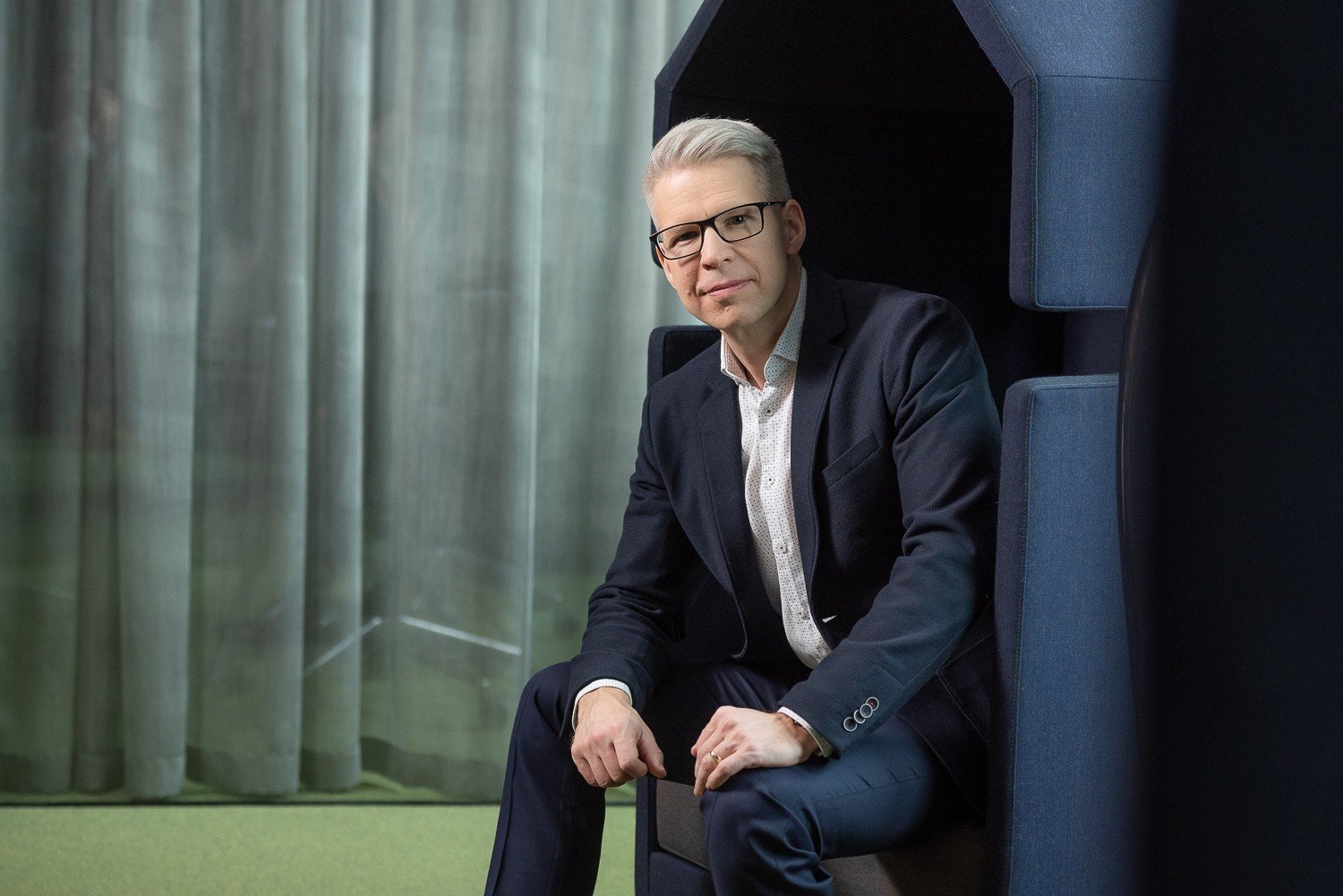
Rait Kondor
Investment Strategist at INVL Family Office
TOP101 – investments drive the economy forward
Special Award for Best Investment – Lemeks Group’s ESTPLY birch plywood mill
As part of the current TOP101 rankings, INVL Family Office decided to award the title of Best Investment to Lemeks Group, whose subsidiary Estonian Plywood (ESTPLY) has made a 25-million-euro investment to expand its existing plywood mill in Jõgeva County, whilst also modernising and upgrading its equipment. Investments drive progress – that is, they increase the prosperity of society. Why is it significant when a single company decides to expand an existing production unit, and how does this affect the Estonian economy and society as a whole?
From a macroeconomic perspective, investments are factored into the calculation of gross domestic product (GDP). GDP can be measured by adding together consumption, investment, government expenditure and net exports.
When it comes to investment, a distinction is made between public and private investment, as private investment is usually expected to yield a direct financial return, whereas public investment can be measured not only in terms of the money recouped but also in terms of social welfare or the creation of conditions for the smooth functioning of society. This generally includes various infrastructure investments, such as road construction, as well as the building of schools and hospitals. So, whilst public social investments can simply be described as expenditure, investments made by private companies are those that are expected to generate a return.
How do investments increase society’s prosperity? Firstly, investments increase production capacity. When companies invest in factories, machinery, technology, infrastructure or research, they will be able to produce more goods and services in the future. These investments increase the economy’s capacity to produce output, which leads to higher growth in gross domestic product.
Secondly, investment improves productivity – that is, how much output can be produced per hour worked. Higher productivity is the main source of long-term growth in developed economies. This is also one of the reasons why GDP per capita in Western European countries is higher than in Estonia. To boost productivity, investments are made in technology, digitalisation, automation and staff training.
Thirdly, investment creates jobs. When a factory or warehouse is built or expanded, such investment generates demand for construction workers, project managers, equipment manufacturers and service providers. In the short term, this creates jobs and generates income; in the longer term, new and modernised businesses continue to create jobs as well.
Fourthly, investment promotes innovation. Investment in research and development leads to new products, new industries and improved production methods. In this area, it is most difficult to assess which activities will yield the greatest benefits for the end result and whether these activities can be successfully implemented.
From the perspective of the national economy, it is important that investments can be expected to trigger a positive economic cycle. As businesses become more productive, employees can earn higher wages, businesses can increase their profits, and this enables governments to collect greater tax revenue. Greater tax revenue, in turn, allows the government to spend more on healthcare, education, infrastructure and social services.
Countries that invest heavily in education, infrastructure, technology and capital-intensive equipment are more competitive internationally. They can produce higher-quality products at lower costs and attract more foreign business activity.
Ultimately, investment creates a growth cycle characterised by a positive feedback loop. Savings enable investment, which leads to higher productivity, which in turn generates higher income, allowing for greater savings, which in turn enables further investment.
There is a saying that ‘do not fear higher costs, but lower revenues.’ In other words, to achieve higher revenues, one must work hard and invest in productivity growth.
One of the most challenging tasks in business is precisely to understand where exactly it is worth investing so that the investment generates such productivity growth and a positive feedback loop.
As part of the TOP101 rankings, INVL Family Office decided to award the title of ‘Best Investment’ to Lemeks Group, whose subsidiary Estonian Plywood (ESTPLY) has made a 25-million-euro investment to expand its existing plywood mill in Jõgeva County, whilst also modernising and upgrading its equipment. This will enable Estonian Plywood to increase its plywood production capacity by 50 per cent, raising the plant’s output from 60,000 cubic metres to 90,000 cubic metres.
Such an investment is significant for several reasons – firstly, it signals that Estonian businesses are confident enough to make major investments in Estonia, despite the uncertain geopolitical situation.
Secondly, the investment is being made in a manufacturing sector that utilises raw materials sourced from Estonia. This enables the creation of added value from birch logs, which would otherwise be shipped across the sea to Sweden or Finland.
Thirdly, there is an important regional policy aspect here. In Estonia, the main economic activity is concentrated around the two major centres of attraction, Tallinn and Tartu, so any investment made outside these cities is very significant from a regional policy perspective.
All in all, it is good that Estonian companies are confident enough to invest and are doing so in sectors where we are internationally competitive, where we possess strong skills, and where we can utilise our natural resources to enhance social welfare.